When the Algorithm Picks Your Color Palette
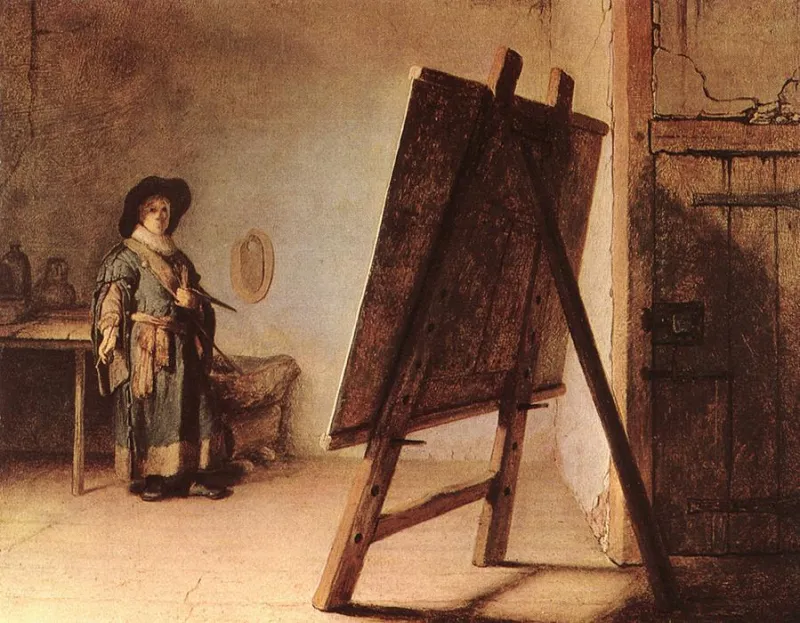
Photo: Rembrandt, Public domain, via Wikimedia Commons
There's a moment every creator recognizes but rarely names: you're mid-project, and a thought flickers through your head that has nothing to do with the work and everything to do with the audience. Will they like this? Should I make it brighter? Maybe I should film the process — that stuff does numbers.
That flicker is tiny. But multiplied across a hundred decisions, a thousand posts, a year of feedback loops, it becomes something else entirely. It becomes the art.
Feedback Is a Drug, and the Dosing Is Out of Your Control
Let's be fair to audiences: feedback is genuinely useful. Artists have always worked in dialogue with viewers — the salon, the gallery opening, the editor's red pen. The problem isn't feedback. It's the velocity and legibility of it. A gallery crowd gives you a mood. An algorithm gives you a spreadsheet.
And spreadsheets are seductive. When your muted, melancholic painting gets 200 likes and your neon, cheerful one gets 4,000, the data is right there, glowing, whispering: make more of that. Every creator I know has felt the pull. Some have followed it all the way to a style they no longer recognize — a portfolio that performs beautifully and means nothing to the person who made it.
Critics have been chewing on this for a while now, and the sharpest framing I've heard comes from working artists themselves: the comment section isn't a conversation, it's a stage. And once you know the audience is watching, you start acting.
The Mirror Test: Is Your Art a Reflection or a Performance?
Here's an uncomfortable exercise. Look at your last ten posts. Now imagine zero people would ever see them. How many would still exist?
If the answer is "all of them," congratulations — you're rarer than you think. If it's "maybe half," you're not broken; you're normal. The creator economy is engineered to blur the line between self-expression and audience service, and the blur is the business model.
The tell-tale signs of drift:
- Your experiments live in a "close friends" folder while your feed stays safely on-brand.
- You've described a piece as "good engagement bait" — out loud, to other people, without flinching.
- You feel anxious when a post underperforms, not because it matters, but because it means something now.
How the Ones Who Resist Actually Do It
The artists who keep their compass intact aren't tougher than everyone else. They've just built guardrails:
They separate the studio from the feed. Physical artists have an advantage here — you can't check likes on a canvas. But the principle scales: make first, post later, ideally on a delay. If the work goes up Tuesday but was finished three weeks ago, the algorithm's opinion arrives after the decisions are already made.
They curate their feedback. One working musician I know has a trusted circle of five people whose opinions she actually weighs. The other 40,000 comments? Ambient noise. She reads them for connection, never for direction.
They schedule the weird stuff. The most disciplined creators I know protect unperformative work the way other people protect gym time. One painter does "no-camera Fridays" — anything she makes that day can never be posted. It sounds gimmicky until you realize it's the only day of the week she feels like herself.
They measure differently. Not every metric is poison. Saves, shares, comments that say something real — these tell you about resonance. Likes tell you about the scroll. Learn which signals are temperature checks and which are just weather.
The Audience You Actually Want
Here's the twist that makes all of this bearable: audiences don't actually want you to perform for them. They want to watch someone do the thing — with conviction, with risk, with the small chance of beautiful failure. The parasocial bond that sustains a career isn't built on giving people what they clicked on. It's built on being someone worth watching figure it out.
The comment section will always be a stage. The trick is remembering that you're not the performer. You're the reason there's a show at all.