Forget Follower Counts — Your Real Audience Is Smaller Than You Think (And That's the Good News)
Let's talk about a number that doesn't get nearly enough respect: 200.
Two hundred people who genuinely care about what you make. Two hundred people who open your emails, share your work without being asked, buy the thing when it drops, and come back every single time. Not because an algorithm surfaced you, not because a post happened to go viral, but because something you created landed in their life at a moment that mattered.
Two hundred people like that will change your creative career. Maybe even your life. And yet most of us are too busy staring at the gap between our follower count and someone else's to notice they're already there, waiting.
The Vanity Metric Trap
We've been trained — by platforms, by industry culture, by the ambient competitive energy of social media — to read follower counts as the primary measure of creative success. More followers means more reach means more influence means more opportunity. The logic feels airtight.
Except it isn't.
The relationship between audience size and meaningful engagement has been weakening for years. Organic reach on most major platforms has cratered. Accounts with hundreds of thousands of followers routinely generate less actual interaction — real conversation, real sales, real community — than smaller accounts with deeply loyal, highly specific audiences. The numbers look impressive in screenshots. They just don't always translate into anything real.
What does translate? Connection. Specificity. The feeling, on both sides of the screen, that something genuine is happening between a creator and their people.
What "True Audience" Actually Means
Your true audience isn't everyone who's ever liked one of your posts. It's not your total follower count, your monthly reach, or your impressions. It's the subset of people for whom your work is not optional — people who would notice if you disappeared, who feel like they have a personal relationship with what you make, who actively look for you rather than passively stumbling across you.
They're the ones who comment with actual sentences. Who send you DMs that start with "I've been following you for years and..." Who buy the print or the course or the zine not because it's cheap but because they trust that what you make is worth their money.
Every creator has some version of this group. Most creators have a much smaller version than they think — but also a much more powerful one than they're giving credit to.
The Mental Health Argument
Here's something I've noticed: creators who orient their work around their true audience — rather than chasing algorithmic growth — tend to report significantly less anxiety about their creative practice.
This isn't just anecdotal. When your sense of creative success is tied to a number that fluctuates based on factors entirely outside your control (platform algorithm changes, trending topics, the random virality of someone else's content), you're essentially gambling with your self-worth every time you post. The emotional rollercoaster is exhausting, and over time it corrodes your relationship with the actual work.
But when you're making something for a specific group of people whose responses you can actually read and feel — when you know that your newsletter is hitting the inboxes of 300 people who genuinely want it — the feedback loop becomes something you can actually build on. It becomes information rather than judgment.
The shift from "how many people saw this?" to "did the right people feel this?" sounds small. It changes everything.
Building Spaces Your True Audience Can Actually Find You In
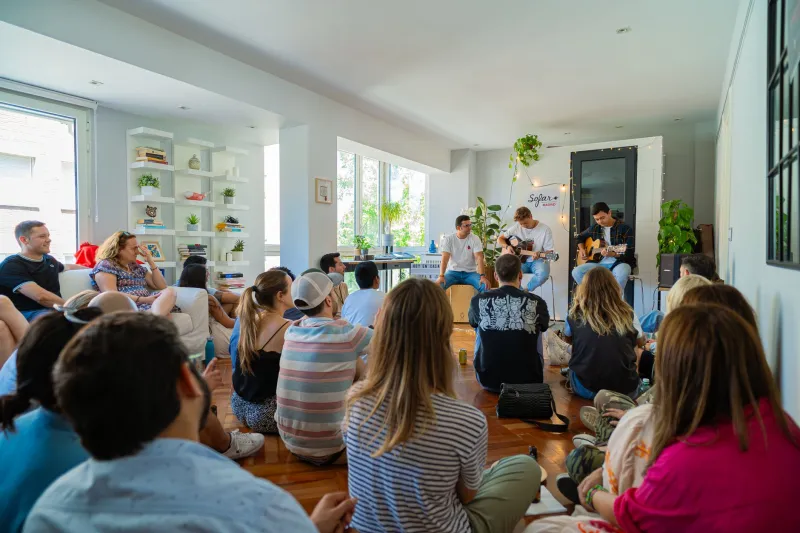
One of the most practical moves a creator can make right now is creating at least one space that exists entirely outside of algorithmic distribution — somewhere your most devoted audience can gather without competing with the noise of a public feed.
This looks different for different creators. For some, it's a newsletter. For others, it's a private Discord, a Patreon tier, a recurring live session, or even a simple group text thread with their most engaged fans. The platform matters less than the principle: a space where the relationship is direct, where the people showing up have actively chosen to be there, and where you can communicate with them without a platform deciding who gets to see it.
These spaces also tend to produce the most honest creative feedback you'll ever receive. The people in your inner circle — the ones who've opted into a closer relationship with your work — are often the ones who can tell you what's resonating, what's falling flat, and what they're hungry for in ways that a public comment section rarely can.
Making Work That Rewards Depth
There's a creative dimension to this too, not just a strategic one. When you're making work for a broad, undefined audience — trying to appeal to as many people as possible — you inevitably sand down the edges. You make things that are accessible rather than specific, familiar rather than surprising.
But when you're making for a smaller, known audience — people whose sensibilities you understand, whose references you share, who trust you enough to follow you somewhere unfamiliar — you can afford to go deeper. More specific. More genuinely strange. The work can be more fully itself because it doesn't need to be everything to everyone.
This is where a lot of the most interesting creative work is happening right now. Not in the feeds optimized for maximum reach, but in the newsletters and the Substacks and the small community spaces where creators are making things that would be too niche, too weird, or too specific to ever go viral — and finding that their true audience loves them for exactly that.
The Number That Actually Matters
I'm not here to tell you that audience growth doesn't matter or that you should ignore reach entirely. A bigger audience can mean more opportunity, more impact, more ability to sustain your creative practice financially. Those things are real.
But if you're measuring your creative worth by the gap between your numbers and someone else's — if you're making decisions about what to create based on what the algorithm is currently rewarding rather than what your actual community needs — you might be optimizing for the wrong thing entirely.
The creators building the most durable, most meaningful, most financially sustainable careers right now are the ones who figured out who their people actually are — and then made everything, every piece of content, every product, every community space, specifically for them.
Two hundred people who actually care. That's not a consolation prize. That's a foundation.