The Work Nobody Claps For: The Real Cost of Creating Something the World Didn't Ask For

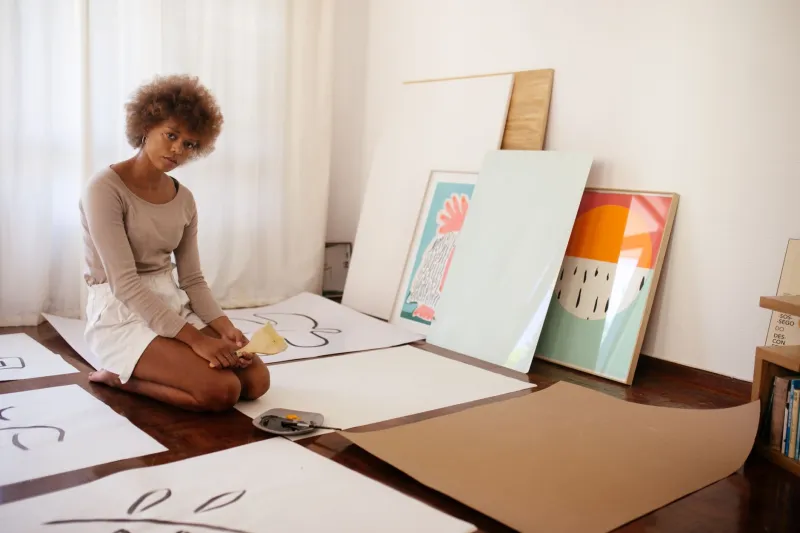
Photo by Photo by Florian Marette on Unsplash on Unsplash
Let's talk about the years before the years.
Not the "I worked really hard" years that make it into the brand story. The ones before that. The ones where you were making something in a vacuum, spending money you weren't sure you'd ever recoup, watching other people your age get promotions and buy houses while you were trying to figure out if your idea even made sense. The ones where the only validation you had was your own gut — and your gut wasn't always convincing.
Creative independence is sold to us as freedom. And it is, eventually, sometimes. But before it's freedom, it's almost always a very long list of costs that nobody itemizes for you upfront.
The Financial Reality Is Weirder Than You Think
The money conversation around creative work is usually framed one of two ways: either the romantic version ("I had nothing and I made it work") or the cautionary version ("don't quit your day job"). Both are real, but neither really captures the specific financial strangeness of building something that doesn't have a market yet.
Because when you're creating work that nobody asked for, you're not just spending money — you're spending money on something whose value is entirely theoretical. That camera, that studio rental, that design software subscription, that course you bought to fill a skill gap — all of it is an investment in a return that may or may not materialize, on a timeline you cannot predict.
And then there's opportunity cost, which is the sneaky one. Every hour you spend on your creative project is an hour you're not billing a client, taking a shift, or building a more conventional career. That gap compounds. Over three years, five years, it starts to feel like a canyon between you and the people who chose more linear paths.
None of this means it's the wrong choice. But it's a real cost, and pretending it isn't doesn't make it go away.
The Self-Doubt Tax Is Enormous
Here's what nobody puts in the budget: the emotional labor of sustained belief in something unvalidated.
When you're building toward an audience that doesn't exist yet, or making art that hasn't found its people, or developing a creative practice in a genre that doesn't have a clear commercial lane — you are doing something genuinely hard. Not just logistically hard. Psychologically hard.
You have to keep deciding, over and over, that the thing is worth making even when no external signal confirms it. That is a specific kind of exhaustion that doesn't show up in your bank account but absolutely shows up in your body, your relationships, and your capacity for creative risk-taking.
I think of it as a tax because it's not optional — it's just part of the cost of operating outside of validated demand. Every creator building something original pays it. The ones who make it aren't the ones who didn't feel it. They're the ones who kept paying it anyway.
The Time Horizon Nobody Warns You About
American culture is particularly bad at sitting with slow timelines. We have a cultural obsession with the fast pivot, the quick win, the overnight success — and even when we intellectually know that's a myth, it still shapes our internal sense of what "normal" progress looks like.
Creative work that's genuinely original — the kind that isn't just a variation on what's already working — often takes longer to find its audience because the audience has to catch up to the work. The work is ahead of where the conversation is. That's the whole point. But it means you're operating in a time horizon that feels deeply abnormal, even when it's actually just how new ideas work.
This is why so many creators abandon projects right before they would have broken through. Not because the work wasn't good enough. Because the gap between effort and return stretched longer than they'd emotionally prepared for, and nobody had told them that the gap was normal — that it was, in fact, a sign they were doing something genuinely new.
What 'Before Anyone Notices' Actually Builds
Here's the thing about those invisible years, though: they're doing something. Even when it doesn't feel like it.
The work you make when nobody's watching is the work that's made entirely for the right reasons. There's no algorithm to optimize for. No comment section to manage. No brand relationship to protect. It's just you and the thing you're trying to make and the question of whether you can make it well. That's an incredibly clarifying environment.
Creators who've gone through this period often describe it as the place where their actual voice developed — not the performed version, not the audience-optimized version, but the real one. Because when there's no audience, you stop performing for one. You just make.
That's not nothing. That's actually the whole foundation.
The Justification That Has to Come From Inside
At some point, every creator building without validation has to answer the same question: why am I doing this?
And the answer can't be "because it'll pay off eventually" — because you genuinely don't know that. It can't be "because people will love it" — because you don't have evidence of that yet. The only honest answer is something closer to: because not making it would cost me something too. Because I'm the kind of person who makes things, and not making this particular thing would be its own kind of loss.
That might sound like a thin justification for the financial hit, the missed opportunities, the years of self-doubt tax. And maybe it is. But it's also the only justification that actually holds up over time, because it's the only one that doesn't depend on an outcome.
The work nobody claps for is still work. The years nobody sees are still years that shaped you. And sometimes the most important thing you'll ever create is the thing you made before anyone thought to ask for it.