Forget the Arena: The Creators Betting Everything on Twenty Folding Chairs
Photo: Didier Descouens, Public domain, via Wikimedia Commons
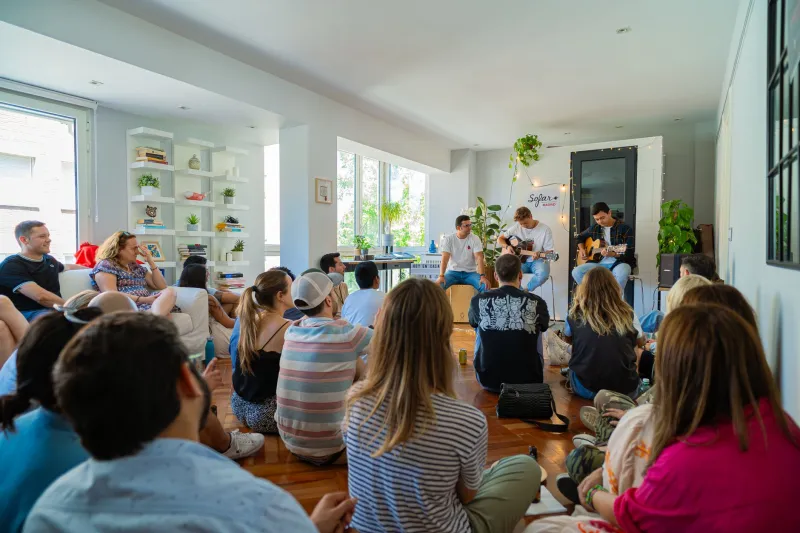
There were nineteen of us in a third-floor walk-up in Bushwick on a Friday in October, twenty if you count the dog — and the host counts the dog. Someone had moved the coffee table against the wall. The chairs did not match. There was a cooler of seltzer, a jar asking for twelve dollars, and at 8:15 a painter named Marcus unrolled a canvas he’d finished three days earlier and talked about it for eleven minutes while we sat close enough to see the brush marks.
No ring light. No comment section. No link in bio.
Welcome to what I’ve been calling the living room era: the quiet, stubborn migration of creators away from the biggest possible screen and toward the smallest possible room.
The number that broke the spell
For a decade the logic was simple — reach more people, and the money follows. In 2026 that equation has gotten weird. A reel that hits 400,000 views might convert into forty newsletter signups and one person asking whether the print comes “in a bigger size, like a poster.” Meanwhile, $12 at the door times nineteen people is $228. Not life-changing, but real — and it came with names attached.
Creators I talk to keep describing the same whiplash. The internet gives you scale. It does not give you presence. And presence is the thing people will pay for now, partly because it has become genuinely scarce.
What a room does that a livestream can’t
I’ve watched a hundred studio tours. I have never once been able to ask a screen why a corner was left unpainted.
In person, three things happen that don’t happen online. First, people see the scale of the work — the actual inches. A six-by-eight-foot canvas reads as wallpaper on a phone and as a wall in a living room. Second, they see you being a person: sweating, stammering, refilling the snack bowl. Third — and this is the one nobody puts in the recap post — they see each other. Half the value of a tiny salon is that a ceramicist meets a tax attorney who collects ceramics and a high school art teacher who wants to bring her class.
Community is not a metric. It’s a side effect of too many people in a small space.
The economics nobody puts on a slide
House shows and salons are not a get-rich plan, and I want to be honest about that. A twenty-person zine swap might gross $300. Run the math on the labor and it’s closer to a hobby than a business.
But the ledger looks different when you count what happens afterward. Two people buy prints off the wall. One asks about a commission. Three sign up for the newsletter because they met you, not because a popup asked them to. A bookseller in the crowd offers to host the next one. Repeat that monthly for a year and you’ve built something an ad budget can’t buy: a list of people who have stood in a room with you.
Also — and I say this with love — the low ceiling is a feature. When the show is small, a flop costs you a Saturday. When the launch is huge, a flop costs you six months and your sense of self.
The unglamorous logistics
Let me be real about what hosting takes, because the aesthetic makes it look effortless.
You need a room that fits people and a bathroom that won’t embarrass you. You need to tell the neighbors. You need a plan for the guest who wants to talk for forty minutes (the plan is a job — hand them the sign-in sheet). You need a time limit: forty-five minutes of program, then unstructured lingering, which is where the good stuff happens. You need a price. Free is fine; $10 to $20 filters for commitment and covers the seltzer. You need someone at the door and, if you’re smart, someone taking photos for ten minutes and then putting the phone down.
And you need to not call it a brand activation. Please.
The formats people are actually running
The variations are endless, but four keep coming up. The salon, where one or two people present unfinished work and everyone argues about it kindly. The house show, which is a concert in a living room with a hat or a QR code by the door. The zine swap, where everyone brings twenty copies of something and leaves with twenty different somethings. And the open studio, the lowest-effort option of all: post the hours, put out the snacks, let people wander.
Studios in Providence, Minneapolis, and East Austin are running these on weekday evenings now, which tells you something. Friday night is for the big room. Tuesday is for the people who actually care.
The part that surprised me
Every creator I asked about their first small gathering described the same aftershock: they liked making things again.
Not because the audience was bigger or the money was better. Because making work in a room with actual people resets the reason you started. You hear someone gasp at the right moment. You watch a stranger stand in front of a piece for ninety seconds. You get a question you would never have thought to ask yourself.
The internet will still be there tomorrow, loud and infinite. But there’s something about nineteen people, mismatched chairs, and a dog that makes the whole thing feel like it’s yours again.
If you’ve been sitting on the idea of a tiny gathering — a reading, a swap, an open studio with bad lighting and good crackers — this is your permission slip. Cap the guest list. Charge a little. Keep it short. Then do it again in six weeks.
The arena isn’t going anywhere. Your living room is right there.