Alone in the Studio: The Radical Case for Creating Without a Crowd
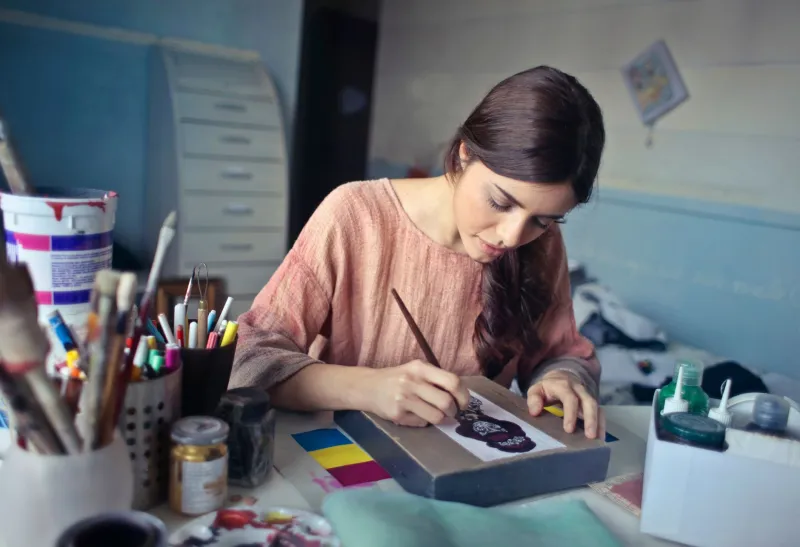
There's a certain kind of pressure that lives in the creator economy right now. It's the pressure to build in public, to document every step, to collab and co-sign and cross-promote until your work feels less like yours and more like a group project nobody fully owns. And honestly? I've felt it too.
But here's the thing I keep coming back to: some of the work I'm most proud of came from the moments when I shut everything — and everyone — out.
The Collaboration Myth We've All Bought Into
Don't get me wrong. Collaboration can be genuinely electric. Two creative minds hitting a frequency together and producing something neither would've reached alone — that's real, and it's beautiful. But somewhere along the way, the culture shifted from collaboration as a tool to collaboration as the default. If you're not co-creating, co-hosting, or co-branding, you start to feel like you're doing it wrong.
The problem is that this constant togetherness doesn't just fragment your time — it fragments your vision. When you're always filtering your ideas through someone else's reaction, you start unconsciously editing yourself before the work even has a chance to breathe. You make it safer. More palatable. More... average.
Neuroscientists call the mental state where your deepest creative work happens deep focus — a condition that requires sustained, uninterrupted attention. Cal Newport, who wrote extensively about this in Deep Work, argues that the ability to focus without distraction is becoming increasingly rare and increasingly valuable. And collaboration, by its very nature, interrupts that state constantly.
What Solitude Actually Does to Your Brain
When you work alone — truly alone, not just physically isolated while still refreshing your DMs — something shifts. Your brain stops performing and starts processing. Ideas that felt half-formed suddenly have room to develop. Connections you couldn't see through the noise of other people's opinions start revealing themselves.
Psychologist Mihaly Csikszentmihalyi spent decades studying what he called flow — that state of effortless, absorbed concentration where your best work tends to emerge. His research consistently showed that flow is most easily achieved in conditions of low external distraction and high internal motivation. In other words: alone, and genuinely invested.
This doesn't mean isolation is the answer to everything. But it does mean that if you're never giving yourself those long, uninterrupted stretches of solo work, you might be leaving your best creative output on the table.
Artists Who Guard the Process
Talk to working artists who've built something genuinely original and you'll notice a pattern. Many of them are almost militantly protective of their early creative process. They don't share works-in-progress. They don't workshop ideas in public. They don't take meetings during their creative hours.
One illustrator I know — based out of Brooklyn, building a quietly devoted following around her intricate, surrealist prints — told me she stopped sharing process videos entirely after a period of intense audience engagement nearly derailed a major series. "Every comment became a vote," she said. "And suddenly I was making work by committee without realizing it."
A musician friend described something similar: the album he made in a rented cabin with no Wi-Fi for three weeks became his most critically acclaimed. The one he made while actively engaging his fanbase online felt, in his words, "like I was trying to win an argument instead of tell the truth."
These aren't isolated stories. They're a pattern.
Building in Public Has Real Costs
The build in public movement has genuine value — transparency, community-building, accountability. I get it. But let's be honest about what it costs. When you share the seed of an idea before it's had time to root, you expose it to the elements too soon. Feedback — even well-intentioned feedback — can calcify your thinking before you've had a chance to fully explore it.
There's also the performance aspect. Once you're documenting your process for an audience, the process itself changes. You start making choices that look good on camera rather than choices that serve the work. That's not a moral failing — it's just human nature. We adapt to observation. But adaptation and authentic creative exploration don't always coexist easily.
Solitude Isn't Antisocial — It's Strategic
Here's what I want to be clear about: advocating for more alone time in your creative practice isn't the same as advocating for isolation from community. Your people matter. Feedback matters. Collaboration, when it's chosen intentionally rather than defaulted to out of cultural pressure, absolutely matters.
But the sequencing matters too. There's a difference between bringing a fully formed idea to a collaborator and building the idea through collaboration. One preserves your original vision and uses partnership to sharpen it. The other can dissolve your vision before you even know what it was.
The most generative creative process I've found — and that many artists I respect seem to have landed on — looks something like this: long stretches of solitary exploration, followed by selective sharing with a very small number of trusted voices, followed by public release. The collaboration happens, but it happens after the core work has been protected long enough to become itself.
Give Your Work Room to Be Weird
The ideas that end up mattering most — the ones that feel genuinely new and specifically yours — rarely survive the early-feedback gauntlet. They're too strange, too unformed, too unlike anything that's already proven to work. They need time in the dark before they're ready for the light.
So if you've been feeling like your work has gotten a little too smooth, a little too collaborative, a little too optimized for approval — maybe the most radical thing you can do right now is close the laptop, silence the group chat, and spend some serious time alone with your own ideas.
Your best work might not be waiting in someone else's creative energy. It might be waiting in yours.